
杨玉超
2006–2010 博士,清华大学
2002–2006 学士,北京科技大学
2022 - 今 长聘教授、博士生导师,北京大学
2019 - 今 主任,北京大学人工智能研究院类脑智能芯片研究中心
2021 – 2022 长聘副教授、博士生导师,北京大学
2015 – 2021 助理教授、博士生导师,北京大学
2013 – 2015 高级研究员,美国密歇根大学安娜堡分校
2010 – 2013 博士后,美国密歇根大学安娜堡分校
人工神经形态器件与类脑计算
基于金属氧化物这一具有复杂的离子动力学、热和电效应及耦合作用丰富的材料体系,本课题组研制出了多款人工神经形态器件,能够高效地完成各种仿生任务以及类脑计算。通过对阻变材料中各种组分占比以及器件几何结构的精心设计,我们能够在小尺度纳米器件里实现多种复杂生物神经系统行为,目前已经设计制造并通过功能验证的器件包括:具有泄漏、累积和发放等行为的NbOx神经元;同时具有长短时程可塑性的ZnO-EMIM人工树突器件;基于YSZ的星型胶质细胞器件;功耗仅为30fJ/spike的超低功耗人工突触器件。基于这些新型神经形态器件,课题组进一步实现了包括时间序列分析、联想记忆等复杂的生物神经功能。与此方向相关的研究成果多次在领域顶级期刊上如Nature Electronics、Nature Communications、Advanced Materials等发表。
基于忆阻器的高效计算系统
针对人工智能算法中计算方式的多样性,本课题组将忆阻器内部动力学特性和忆阻器阵列在存内计算方面的优势有机结合,高效地实现了包括矩阵向量乘法、衰减运算以及随机数生成在内的多种在传统计算平台中代价高昂的运算,进而在多种不同类型的人工智能硬件计算系统中达到了极低的功耗。目前代表性的系统主要包括:基于二维铁电材料α-In2Se3的短时程可塑性实现的储备池计算系统,该系统能够以极低的功耗有效地处理复杂的时序信息;基于相变存储器 PCM 电导漂移行为的资格迹计算系统,该系统能够利用PCM电导漂移导致的衰减高效地实现资格迹机制并能有效加速强化学习的训练过程;基于TaOx长时程可塑性的优化问题求解系统等。该方向的研究成果多次发表在如 Science Advances、Advanced Materials、IEDM 等微电子领域内顶级期刊和杂志中。
面向人工智能的忆阻器芯片设计与制造
针对高能效神经网络处理硬件,本课题组研究了面向存内计算的高性能阻性存储器集成工艺、多值存储器件、高效读写和计算电路以及系统级芯片架构等,重点解决器件性能优化和先进工艺集成、模数接口电路设计与软硬件协同设计等存内计算架构中的关键问题。
面向人工智能的忆阻存算一体化芯片设计与制造
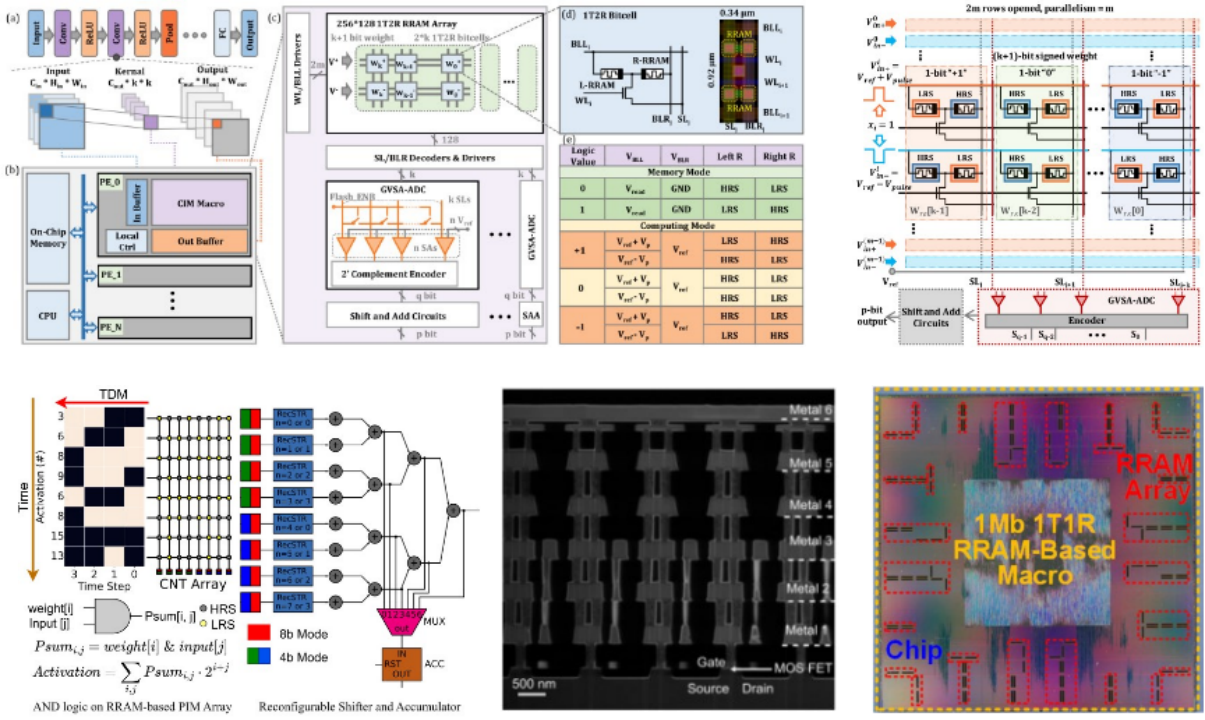
随着人工智能的飞速发展,以深度学习为代表的先进算法模型的参数量和计算量逐年激增,这对以冯诺依曼架构为主的传统计算硬件平台提出了新的挑战。本课题组聚焦边缘端智能应用和云端大数据应用所面临的大算力及高能效需求,研究面向忆阻存算一体化芯片的高效存储器电路设计、高性能模数转换电路设计、先进算子加速核心设计、多核心片上网络架构设计,先进算法模型压缩和本地高效部署。课题组与代工厂长期保持紧密合作,该方向的研究成果已发表在诸如JSSC和TCAS-I等芯片设计领域顶级期刊中。
2021 2021爱思唯尔“中国高被引学者”
2021 全球前2%顶尖科学家榜单
2020 2020爱思唯尔“中国高被引学者”
2020 全球前2%顶尖科学家榜单
2020 国家重点研发计划项目执行优秀团队
2020 霍英东教育基金会青年教师基金
2019 科学探索奖
2019 Wiley青年研究者奖(Wiley Young Researcher Award)
2018 麻省理工科技评论中国区35岁以下科技创新35人
2017 求是杰出青年学者奖
编辑/编委
副主编,APL Machine Learning | AIP
副主编,Microelectronic Engineering | Elsevier
副主编,Nano Select | Wiley
国际顾问委员会成员,Advanced Electronic Materials | Wiley
学科编委,《国家科学评论》(National Science Review, NSR)
青年编委,《中国科学:信息科学》
青年编委,《电子学报》| Chinese Journal of Electronics
编委,Chip
编委,Scientific Reports
客座编辑,Advanced Intelligent Systems
客座编辑,中国图象图形学报“类脑视觉”前沿专题
客座编辑,Neuromorphic Computing and Engineering
客座编辑,Journal of Semiconductors
客座编辑,Chinese Physics B
客座编辑,SCIENCE CHINA Information Sciences
编委,集成电路产业系列丛书
Paper list: https://yanglab.cibr.ac.cn/Publications/index.htm
Representative Publications:
1. Keqin Liu, Teng Zhang, Bingjie Dang, Lin Bao, Liying Xu, Caidie Cheng, Zhen Yang, Ru Huang*, and Yuchao Yang*, An optoelectronic synapse based on α-In2Se3 with controllable temporal dynamics for multimode and multiscale reservoir computing. Nature Electronics, DOI: 10.1038/s41928-022-00847-2, 2022.
2. Bingjie Dang, Keqin Liu, Xulei Wu, Zhen Yang, Liying Xu, Yuchao Yang*, and Ru Huang*, One-phototransistor-one-memristor Array with High-linearity Light-tunable Weight for Optic Neuromorphic Computing. Advanced Materials, 2204844, 2022.
3. Liying Xu, Jiadi Zhu, Bing Chen, Zhen Yang, Keqin Liu, Bingjie Dang, Teng Zhang, Yuchao Yang*, and Ru Huang*, A Distributed Nanocluster Based Multi-Agent Evolutionary Network System. Nature Communications, 13, 4698, 2022. Editor’s Highlight.
4. Rui Yuan, Qingxi Duan, Pek Jun Tiw, Ge Li, Zhuojian Xiao, Zhaokun Jing, Ke Yang, Chang Liu, Chen Ge, Ru Huang*, and Yuchao Yang*, A Calibratable Sensory Neuron Based on Epitaxial VO2 for Spike-based Neuromorphic Multisensory System. Nature Communications, 13, 3973, 2022.
5. Keqin Liu, Bingjie Dang, Teng Zhang, Zhen Yang, Lin Bao, Liying Xu, Caidie Cheng, Ru Huang*, and Yuchao Yang* Multilayer Reservoir Computing Based on Ferroelectric α-In2Se3 for Hierarchical Information Processing. Advanced Materials, 2108826, 2022.
6. Suhas Kumar*, Xinxin Wang, John Paul Strachan, Yuchao Yang*, and Wei D. Lu*, Dynamical Memristors for Higher-Complexity Neuromorphic Computing. Nature Reviews Materials, https://doi.org/10.1038/s41578-022-00434-z, 2022.
7. Yingming Lu, Xi Li, Bonan Yan, Longhao Yan, Teng Zhang, Zhitang Song*, Ru Huang*, and Yuchao Yang*, In-Memory Realization of Eligibility Traces Based on Conductance Drift of Phase Change Memory for Energy-Efficient Reinforcement Learning. Advanced Materials, 34, 2107811, 2021.
8. Longhao Yan, Xi Li, Yihang Zhu, Bonan Yan, Yingming Lu, Teng Zhang, Yuchao Yang*, Zhitang Song*, and Ru Huang*, Uncertainty Quantification Based on Multilevel Conductance and Stochasticity of Heater Size Dependent C-doped Ge2Sb2Te5 PCM Chip. IEDM Tech. Dig. 605-608, 2021.
9. Yingming Lu, Xi Li, Longhao Yan, Teng Zhang, Yuchao Yang*, Zhitang Song*, and Ru Huang*, Accelerated Local Training of CNNs by Optimized Direct Feedback Alignment Based on Stochasticity of 4 Mb C-doped Ge2Sb2Te5 PCM Chip in 40 nm Node. IEDM Tech. Dig. 797-800, 2020.
10. Ke Yang, Qingxi Duan, Yanghao Wang, Teng Zhang, Yuchao Yang*, and Ru Huang*, Transiently chaotic simulated annealing based on intrinsic nonlinearity of memristors for efficient solution of optimization problems. Science Advances, 6, eaba9901, 2020.
11. Qingxi Duan, Zhaokun Jing, Xiaolong Zou, Yanghao Wang, Ke Yang, Teng Zhang, Si Wu, Ru Huang*, and Yuchao Yang*, Spiking Neurons with Spatiotemporal Dynamics and Gain Modulation for Monolithically Integrated Memristive Neural Networks. Nature Communications, 11, 3399, 2020. Editors’ Highlight.
12. Ilia Valov* and Yuchao Yang*, Memristors with alloyed electrodes. Nature Nanotechnology, 15, 510-511, 2020.
13. Yuchao Yang* and Ru Huang, Probing memristive switching in nanoionic devices. Nature Electronics, 1, 274–287, 2018.
14. Jiadi Zhu, Yuchao Yang*, Rundong Jia, Zhongxin Liang, Wen Zhu, Zia Ur Rehman, Lin Bao, Xiaoxian Zhang, Yimao Cai, Li Song & Ru Huang, Ion Gated Synaptic Transistors Based on 2D van der Waals Crystals with Tunable Diffusive Dynamics. Advanced Materials, 30, 1800195, 2018.
15. Yuchao Yang*, Xiaoxian Zhang, Liang Qin, Qibin Zeng, Xiaohui Qiu*, Ru Huang*, Probing Nanoscale Oxygen Ion Motion in Memristive Systems. Nature Communications 8, 15173, 2017.
16. Yuchao Yang, Bing Chen, and Wei D. Lu, Memristive Physically Evolving Networks Enabling Emulation of Heterosynaptic Plasticity. Advanced Materials 27, 7720-7727, 2015.
17. Yuchao Yang, Peng Gao, Linze Li, Xiaoqing Pan, Stefen Tappertzhofen, Shinhyun Choi, Rainer Waser, Ilia Valov and Wei D. Lu, Electrochemical dynamics of nanoscale metallic inclusions in dielectrics. Nature Communications 5, 4232, 2014.
18. Yuchao Yang, Jihang Lee, Seunghyun Lee, Che-Hung Liu, Zhaohui Zhong, and Wei Lu, Oxide Resistive Memory with Functionalized Graphene as Built-in Selector Element. Advanced Materials 26, 3693-3699, 2014.
19. Yuchao Yang, Shinhyon Choi, and Wei Lu, Oxide Heterostructure Resistive Memory. Nano Letters 13, 2908-2915, 2013.
20. Yuchao Yang, Peng Gao, Siddharth Gaba, Ting Chang, Xiaoqing Pan, and Wei Lu, Observation of Conducting Filament Growth in Nanoscale Resistive Memories. Nature Communications 3, 732, 2012.
Book Chapters:
1. Qingxi Duan, Zhuojian Xiao, Ke Yang and Yuchao Yang*, “Neuromorphic Computing Based on Memristor Dynamics”, in Near-sensor and In-sensor Computing, Yang Chai, and Fuyou Liao (eds.), Springer Nature, 2022.
2. Yuchao Yang, Yasuo Takahashi, Atsushi Tsurumaki-Fukuchi, Masashi Arita, M. Moors, M. Buckwell, A. Mehonic, and A. J. Kenyon, Probing electrochemistry at the nanoscale: in situ TEM and STM characterizations of conducting filaments in memristive devices, in Resistive Switching: Oxide Materials, Mechanisms, Devices and Operations, Jennifer Rupp, Daniele Ielmini and Ilia Valov (eds.), Springer, 2022.
3. Yuchao Yang*, Ke Yang and Ru Huang*, “Neuromorphic Devices and Networks Based on Memristors with Ionic Dynamics”, in Handbook of Memristor Networks, Leon Chua, Georgios Sirakoulis, and Andrew Adamatzky (eds.), Springer, 2018.
4. Yuchao Yang, Ting Chang and Wei Lu, “Memristive Devices: Switching Effects, Modeling, and Applications” in Memristors and Memristive Systems, Ronald Tetzlaff (ed.), Springer, 2014.
5. Yuchao Yang, Wei Lu, “Resistive-Random Access Memory Based on Amorphous Films”, in Nonvolatile Memories: Materials, Devices, and Applications, Tseung-Yuen Tseng and Simon M. Sze (eds.), American Scientific Publishers, 2012.